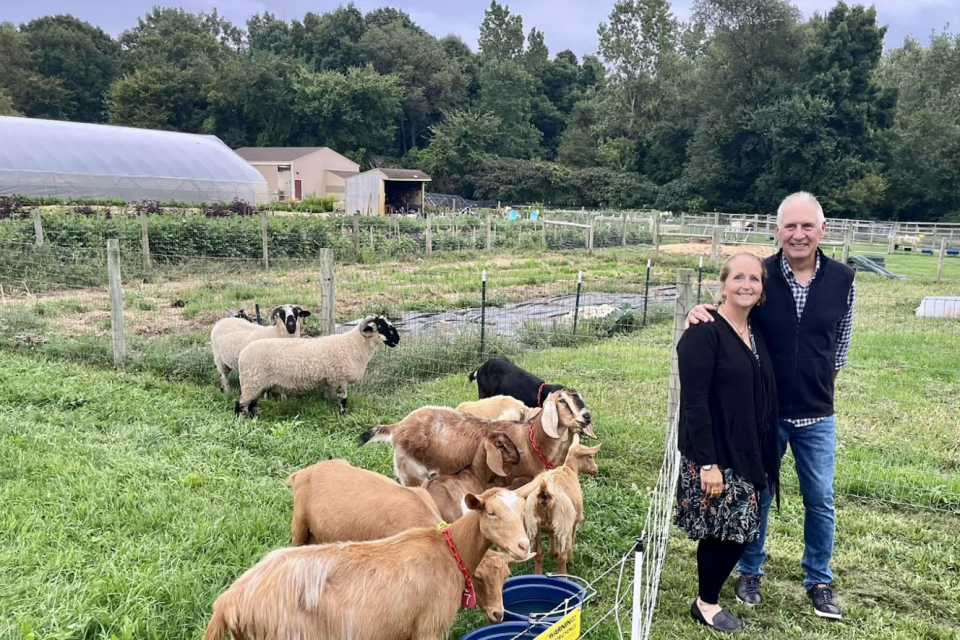
Cardinal Farms is owned and operated by Rich and Cindy Kern, first-generation farmers who stepped away from careers in banking, ministry, and business development to build a farm rooted in land, food, and community. Their path into agriculture began through volunteer work at Maybury Farm in Northville, Michigan, where Cindy eventually became director of the educational farm. What began as service gradually became a new direction. Working with livestock, tending crops, and welcoming visitors onto the farm showed the Kerns how powerful it could be for people to reconnect with the origins of their food.
Those early years shaped the philosophy that now guides Cardinal Farms. The Kerns believe that while very few people will become farmers, every person participates in the food system as a consumer. By creating opportunities for families to experience agriculture firsthand - harvesting vegetables, meeting animals, or working together on the farm - they believe people develop a deeper understanding of how food is produced and a stronger commitment to supporting responsible farming practices.
In 2019, Rich and Cindy purchased their first farm property and began building Cardinal Farms into a diversified operation. Cindy strengthened her agricultural training through Michigan State University’s Organic Farmer Training Program while the couple developed vegetable production, pasture-based livestock, and a growing CSA program. Within just a few seasons, the farm was serving more than one hundred families while hosting farm camps, school visits, and hands-on learning experiences that helped children and families reconnect with the land.
The next chapter of Cardinal Farms will see the farm relocate to a new 12 acre property in Dexter, Michigan. This move opens the door for the Kerns to expand vegetable and flower production, serve more families through their CSA and markets, and reintroduce the on-farm experiences that have always been central to their vision. In recent years, local government restrictions at their previous property limited their ability to host visitors and educational programs. The new farm, located about forty minutes away and on a larger footprint, will once again allow the Kerns to welcome families onto the land and offer the kinds of meaningful farm interactions that first inspired them to begin farming.
These experiences are more than events. They are opportunities for people, especially children, to develop a lasting understanding of where food comes from and the care required to raise animals and grow crops responsibly. At the same time, the return of on-farm programs strengthens the farm’s long-term resilience by creating diversified revenue streams alongside produce, flowers, and livestock. In Michigan’s cold winters, when field production slows and perennial flowers require only minimal tending, these additional income sources help sustain the farm and the community it serves.
Together, Rich and Cindy bring complementary strengths to the farm. Cindy leads vegetable production, crop planning, and educational programming, drawing on both her formal agricultural training and her experience building successful farm education programs. Rich manages livestock care, infrastructure, and the ongoing work of building and maintaining the farm. Their shared vision is to steward land and livestock in ways that nourish their community while creating opportunities for people to reconnect with food, farming, and the natural world.
Ecological, Social, and Economic Stewardship Practices
Cardinal Farms is a family-owned farm focused on nurturing the land through regenerative practices, raising produce, eggs, and livestock with care and intention. They maintain a number of practices to strengthen the resilience and health of the farm and their surrounding community including:
Ecological Stewardship:
- Employing a range of regenerative techniques designed to build soil fertility, structure, and long-term resilience. These include maintaining continuous soil cover, minimizing tillage, and planting cover crops. Heavy machinery is avoided to prevent soil compaction, and conventional chemical inputs are prohibited.
- Focusing on pasture health through a carefully managed rotational grazing system. Animals are moved every 3–4 days to promote even grazing and pasture recovery. Chickens follow behind the small ruminants, helping distribute nutrients, reduce pests, and enhance overall pasture productivity.
- Raising pastured pork with year-round access to pasture, allowing animals to derive roughly 90% of their diet from diverse grasses and natural forage, supplemented with non-GMO grain feed.
- Following the Integrated Pest Management (IPM) Pyramid, prioritizing prevention as the first line of defense. Management strategies progress through cultural, physical, and biological controls, with chemical intervention used as a last resort. Only OMRI-certified products are applied when treatment is necessary.
Social Stewardship:
- Investing in the local community by hosting educational and community-centered events, including school field trips, farm-to-table dinners, and a volunteer program that brings people closer to the land.
- Supporting the broader community through donations to local schools, nonprofit partners such as the Active Faith Food Bank and The Ivy Table Café (a pay-what-you-can café).
- Encouraging CSA members to experience the farm beyond their weekly share—spending time on the grounds, building a relationship with the land, and reconnecting with the source of their food.
Economic Stewardship:
- Sourcing farm inputs as locally as possible. Key soil amendments—including poultry manure, compost, and potting soil—are sourced from Morgan Composting in Michigan.
- Operating as a 100% family owned farm. This independent ownership allows them to maintain full control over farm decisions, ensuring that every choice—from soil management to community engagement—remains aligned with their core values and long-term commitment to environmentally responsible farming.