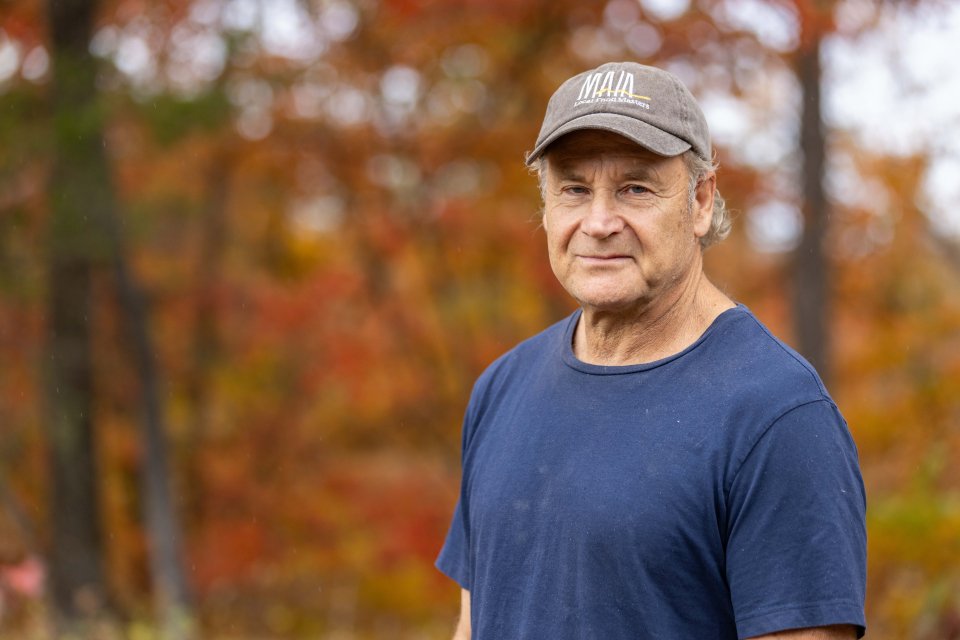
Russ Kremer is a fifth-generation farmer who has spent his life working on the land his family has stewarded for more than a century in Frankenstein, Missouri. He began caring for animals as a young child and developed an especially strong connection to pigs early on, learning through direct experience that the way animals are treated shapes their health, behavior, and productivity. That early understanding stayed with him, even as he pursued formal training in animal husbandry and returned to the farm committed to building a viable future in agriculture. Over time, like many farmers of his generation, Russ was pushed toward more conventional models of production in an effort to increase efficiency and remain economically competitive.
That shift came at a serious cost. As the farm became more confined and dependent on routine antibiotics, Russ saw animal health decline and found himself caught in a cycle of treatment, intervention, and rising stress. The turning point came when he suffered a near-fatal antibiotic-resistant infection after being injured by a boar, an experience that forced him to confront the consequences of the system he had adopted. Rather than leave farming behind, Russ chose to rebuild his operation around a different set of principles. Since 1989, Wildwood Farm has operated an antibiotic-free pork system built on a closed herd, outdoor living conditions, non-GMO feed, and management practices designed to support animal health through natural resilience rather than routine pharmaceutical use.
Russ’s agricultural philosophy is rooted in the belief that healthy soils, healthy animals, and healthy people are inseparable. His work reflects a long-term commitment to regional food systems, humane livestock care, biological farming, and practical models that reduce dependency on centralized infrastructure. Beyond the farm itself, he has spent decades advocating for family farmers and helping develop markets for differentiated pork products, including through the farmer-led cooperative work that helped lay the foundation for True Story Foods. As Wildwood enters its next chapter, Russ is building a more localized, vertically integrated model through his on-farm processing business, Ozark Plateau Pork, LLC, alongside micro-scale value-added production and expanded research and demonstration capacity. That vision will also include a dedicated plot honoring his late brother, Dr. Robert Kremer, so that his work in soil research can continue through on-farm study, education, and demonstration.
Ecological, Social, and Economic Stewardship Practices
Wildwood Farm has a pasture-centered model to raise healthy, free-roaming heirloom pigs. They are focused on a transparent and high quality food chain. Their business practices are centered around ecological stewardship and ensuring dignity to their workers, farmers, community, animals and the planet for this generation and the next. They employ the following practices on their farm:
Ecological Stewardship:
- Regular soil, compost, and plant tissue testing guide precise nutrient management and support healthier pastures and livestock.
- Pigs live communally in forests and are naturally weaned, cattle are rotationally grazed, and laying hens have continuous outdoor access and live out their natural lifespan.
- Pigs are processed humanely on-site, eliminating transport stress and focusing on a high standard of animal welfare at harvest.
- The farm uses minimal- and no-till practices, year-round ground cover through cover crops and mulching, crop rotation, and on-farm compost production to build soil health.
- The on-site processing facility has reduced the average food miles for meat products from approximately 600 miles to 20 miles, significantly shortening the supply chain.
- Livestock harvest forage directly from the land. Pigs are strategically grazed in forested areas to manage invasive species, and once cleared, those areas are replanted with cover crops and beneficial trees, including oaks, to restore the ecosystem.
Social Stewardship:
- Russ Kremer has been an active leader in the sustainable agriculture movement since the 1980s, teaching practical skills and leadership to young farmers and supporting the next generation of agricultural stewards.
- For more than 15 years, Kremer has donated approximately 10,000 pounds of meat annually to local nonprofits, helping strengthen food access in the region.
- He employs six community members, offering wages that begin well above the county minimum and providing a stipend that covers 75% of health insurance costs.
Economic Stewardship:
- More than 55% of pig feed is grown on-site, with the remainder sourced from farms within 10 miles. About 40% of seed is produced on the farm, while the remaining 60% is purchased locally within 40 miles.
- All fertilizers and compost are produced on-site, supporting greater control over soil health and input management.
- As the sole owner of Wildwood Farm and Cedar Creek Eco Farm, Kremer oversees all decision-making, allowing for consistent implementation of regenerative and sustainable practices.
Stewardship Statement
Russ Kremer is a fifth-generation farmer raising livestock with soil health, biodiversity, and animal welfare as core priorities. Throughout the term of this loan, Wildwood Farm pledges to:
- Provide livestock with year-round access to pasture or forested areas, allowing animals to express their natural behaviors.
- Maintain organic practices by prohibiting the use of synthetic fertilizers, herbicides, and pesticides, and by never administering subtherapeutic antibiotics to livestock.
- Pursue USDA Organic certification for all farmland and maintain Global Animal Partnership (GAP) Level 4 Animal Welfare certification.
- Build soil health through minimal tillage, year-round ground cover, and on-site compost production.
- Prioritize local sales, with a goal of keeping at least 70% of sales within a 50-mile radius and sourcing farm inputs on-site or within 40 miles whenever possible, helping reduce food miles.